
Performance
Fast, light and quiet
Irori is one native Rust process drawn on your GPU: about 88 MiB of memory, zero CPU while idle and a 76 MB program, against 478 MiB for Heroic on the same PC.
1 min read
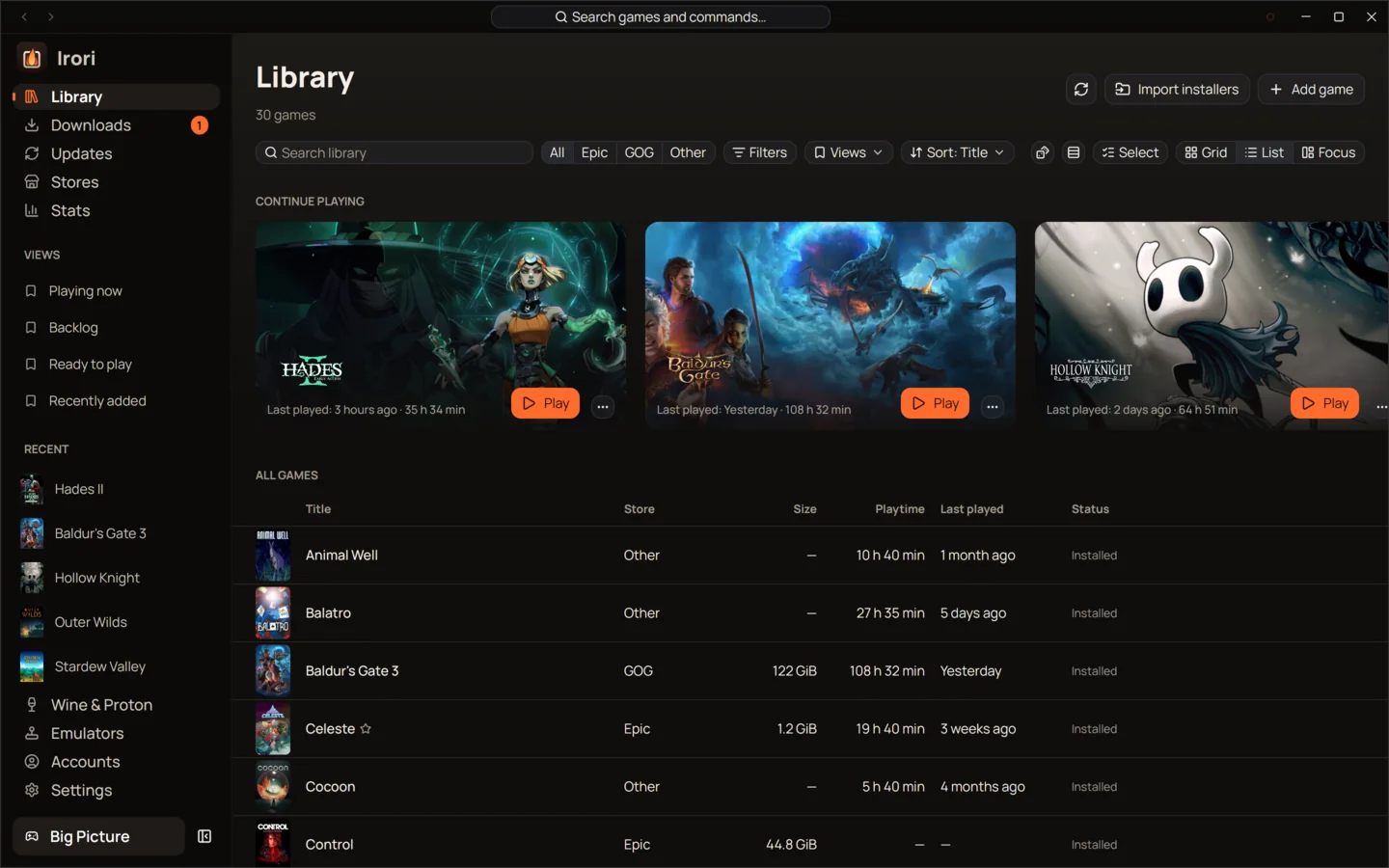
- One processThe whole launcher is one native program, with no browser engine inside its window.
- Drawn on your GPUThe interface is rendered by GPUI on your graphics card.
- Zero CPU while idleNothing polls when nothing happens, down to the controller thread.
- Bounded memoryArt is thumbnailed once to disk and kept in a bounded GPU cache.
- Virtualized listsOnly what is on screen exists, so thousands of games scroll smoothly.
- Live language switchChange between 19 languages without a restart.
The numbers
Measured on Irori 0.2.0 on Linux with an empty profile and the window open:
| Irori 0.2.0 | Heroic Games Launcher 2.22.4 | |
|---|---|---|
| Memory | about 88 MiB | about 478 MiB |
| Processes | 1 | 7 |
| CPU while idle | 0 % | not measured |
| Program size | 76 MB | not measured |
Heroic ran on the same PC. A large library hasn’t been measured yet.
Why it’s light
Irori is written in Rust with GPUI, and draws its interface on your graphics card. There is no Electron and no browser inside the window: store sign-in runs in a separate small program only while you sign in. A small runtime with three worker threads handles network and disk work, so the interface never waits on I/O.
Cover art is downloaded once, cut into thumbnails per size and stored on disk, then held in a bounded GPU cache; at most two images are decoded at a time. Every long list is virtualized, filtered and sorted lists are rebuilt only when their inputs change, and nothing polls while nothing happens.
Calm on your system
When you play, Irori keeps your computer awake and otherwise stays out of the way. Downloads use a dedicated engine with parallel chunks, and update checks for tools happen once a session and daily, from lists cached for a day.
Keep reading
- LibraryOne library for every game you ownEvery store, your ROMs and your own games in one grid that stays smooth at thousands of covers.
- Big PictureBig Picture, made for the couchThe whole launcher with a controller, opening by itself in the Steam Deck’s Game Mode and scaled for a TV.
- Downloads and updatesDownloads that finish, updates in one placeA queue that pauses offline and resumes after a restart, and one Updates page for games and tools.
Ready to light the fire?
Irori is free, open source and installs from the package manager you already use.
Download Irori